

Pipeline Blog
Actionable sales, outbound, and GTM insights from the team building pipeline every day.
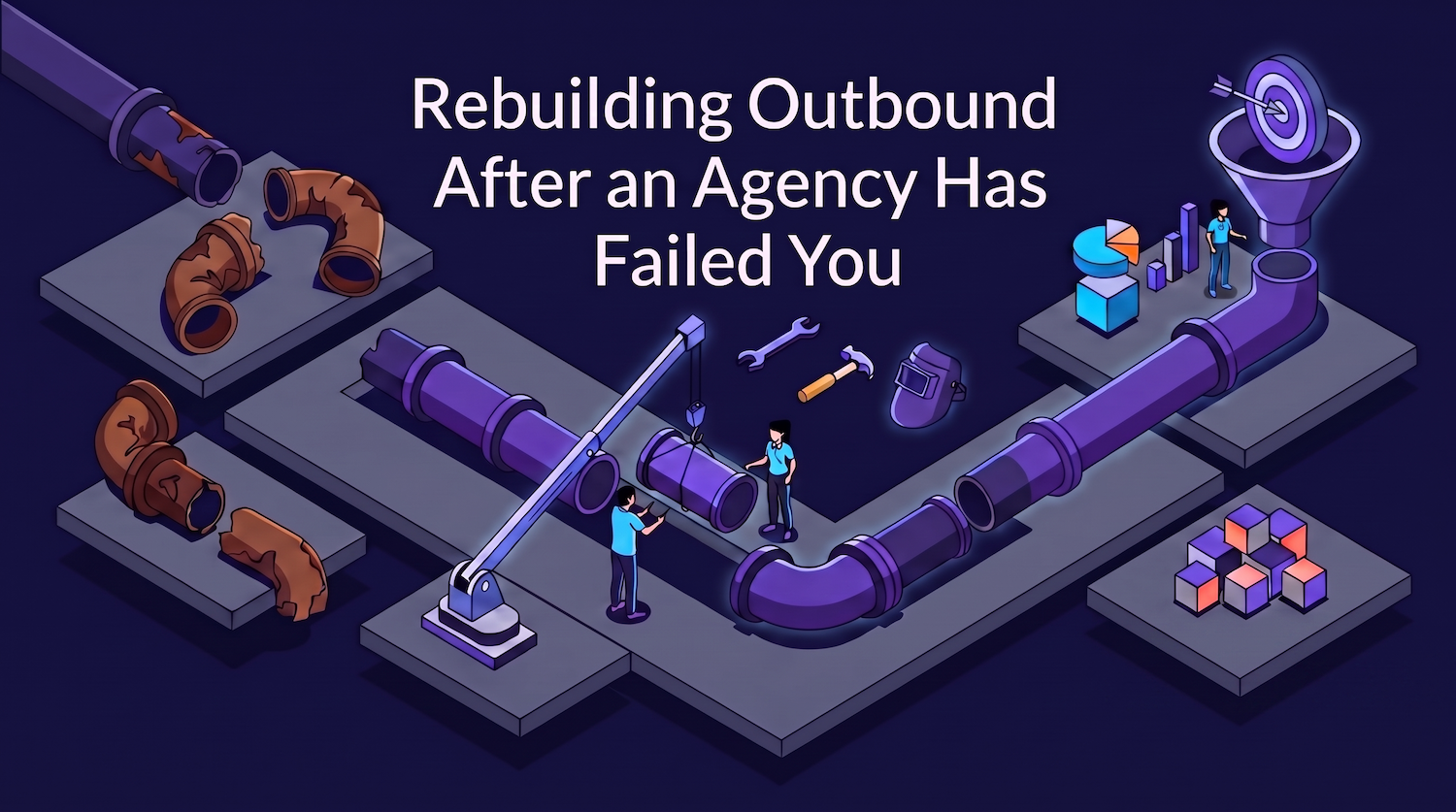

Run a nine-question post-mortem
The first five questions identify what you experienced:
- Did the agency over-promise and under-deliver?
- Were expectations misaligned?
- Was there a lack of transparency?
- Were plenty of meetings booked, but very few converted?
- Were too few meetings booked?
The next four help explain why:
- Where did the data come from, and was it fresh and validated?
- What changed between the first and third month?
- What did the technology actually do?
- What access did you have to the person making the calls?
These are different failures and require different remedies.
1. Over-promising and under-delivery
Over-promising begins in the agency’s sales process. If the forecast used to win the contract was unrealistic, the engagement was measured against the wrong expectation from the start.
Changing supplier may solve this, but only if the next provider sets expectations using evidence rather than another generic meetings promise.
2. Misaligned expectations
Misalignment is usually a specification failure.
Before work begins, both sides should agree what a qualified meeting means, who can decide that a meeting does not count and how long the ramp period is expected to take.
Without that agreement, the client and agency may be working towards different definitions of success.
3. Weak transparency
Weak transparency is a reporting failure.
Before signing, establish what reporting you will receive, how often and in how much detail.
Headline activity figures are not enough if they do not explain what is working and what is changing.
4. Plenty of meetings, but few conversions
This is an outcome rather than a diagnosis.
The meetings may have been poorly qualified or aimed at the wrong buyers. But also examine the internal sales process: qualified meetings are difficult to close when follow-up, skills or capacity are weak.
Were the meetings fundamentally wrong, or were suitable opportunities not converted after handover?
5. Too few meetings
Low meeting volume can be caused by an unclear ideal customer profile, weak messaging, poor data, ineffective execution or a lack of optimisation.
Increasing activity does not fix those problems. It normally exposes more of the same audience to the same ineffective approach.
Examine how the campaign was operated
6. Was the data fresh and validated?
People change jobs, companies are acquired and domains change.
An SDR working from stale data wastes time on dead addresses and wrong-fit companies. Activity cannot compensate for that.
Ask where the data came from and how it was cleaned, enriched and validated.
7. What changed over time?
Segmentation and messaging are hypotheses, not permanent settings.
If nothing changed between month one and month three, the campaign was executed rather than optimised. It should generate evidence about which companies, buyers and messages produce engagement, and that evidence should shape what happens next.
8. What was the technology actually for?
“Technology-enabled outbound” can mean two different things.
Personalisation at scale multiplies output, but the edge comes from utilizing tools and AI for tasks such as account scoring, context gathering, drafting and SDR feedback and training. The difference shows up in meeting quality more than count.
The strongest use of technology supports human judgement rather than replacing it.
9. Did you have access to the SDR?
Hearing your product pitched cold by the person representing you shows whether they understand your value proposition, buyers and likely objections—and whether they can hold a credible conversation.
Would the failure follow you?
Three things need to be in place for outsourced sales development to work:
- A clear understanding of who your customers are
- A value proposition that survives a cold conversation
- Someone internally with the capacity to close what gets booked
Change the supplier in your head while leaving everything else untouched. Would the outcome improve?
If not, another part of the system also needs attention. That does not excuse poor agency delivery; it reduces the risk of repeating the failure.
What to agree before signing again
Three agreements remove much of the ambiguity that damages outsourced outbound engagements.
Whose definition of a qualified meeting applies?
Our view is that the standard should be the client’s and agreed before work begins.
Qualification is part of the targeting specification. Whoever defines it influences who is contacted and which conversations reach sales.
What reporting will you receive?
Ask exactly what you will see and how frequently you will see it.
Useful reporting should show what is happening, what is being learned and what is changing as a result, not simply confirm that activity took place.
When will feedback happen?
Provide feedback after every meeting from the beginning. Explain what was relevant, what was not and whether the opportunity matched the agreed criteria.
Do not wait until 20 meetings have taken place before saying they are wrong. Until feedback is provided, the agency continues working from the original specification and any misunderstanding is repeated. We ask for feedback on every meeting to ensure we’re delivering as expected.
How we do it at Pipeline
After a failed engagement, the next provider should be able to show how its delivery model addresses the causes you have identified—not simply make a different promise.
A strong partner should demonstrate five connected capabilities:
- Qualification: Meetings are assessed against criteria agreed before outreach begins, so both sides share the same definition of suitability.
- Data and targeting: Target lists are built and refined using clean, enriched data rather than treated as a one-off input.
- Execution: Messaging is tailored to the market, buyer and problem, then adjusted as the campaign produces evidence.
- Optimisation: Activity, engagement and outcomes influence targeting and messaging while the campaign is running.
- Reporting and access: Clients can see what is happening, understand what is changing and communicate with the people managing and delivering the work.
Underneath all five sits the ICP and messaging work completed at the start of an engagement. Technology supports account scoring, context gathering, drafting, campaign analysis and SDR development. Its role is to make an expert SDR better at the job, not replace them.
Clients also meet the person working on their project and hear how they would pitch the product cold. This happens after they become a client, rather than during the sales process.
Frequently asked questions
How do I know whether the agency was the problem?
Look at where the failure occurred.
Unsupported forecasts, poor-quality data, weak execution, limited reporting and a lack of optimisation point towards the agency. However, unclear targeting, an unproven value proposition, slow follow-up or limited closing capacity may indicate that the problem was shared.
What needs to be in place before appointing another provider?
You need a clear understanding of your customers, a value proposition that works in a cold conversation and someone internally who can progress the meetings generated.
These foundations are required whether sales development is outsourced or built internally.
Before you sign anything
Answer the nine questions in writing before speaking to another provider.
The exercise will help you separate the failures that belonged to the previous agency from the issues that need to be corrected before the next campaign begins. That diagnosis should determine what you buy next.
If you want to work through the rebuild with Pipeline, we can begin with a one-month engagement to keep the initial risk low.
Sources
Before replacing an outbound sales agency, diagnose what actually failed.
A poor engagement may involve over-promising, weak transparency, poor meeting quality or too few meetings. The cause could be the data, a lack of optimisation, the technology or the person making the calls.
Changing supplier may solve some problems. Others may follow you.
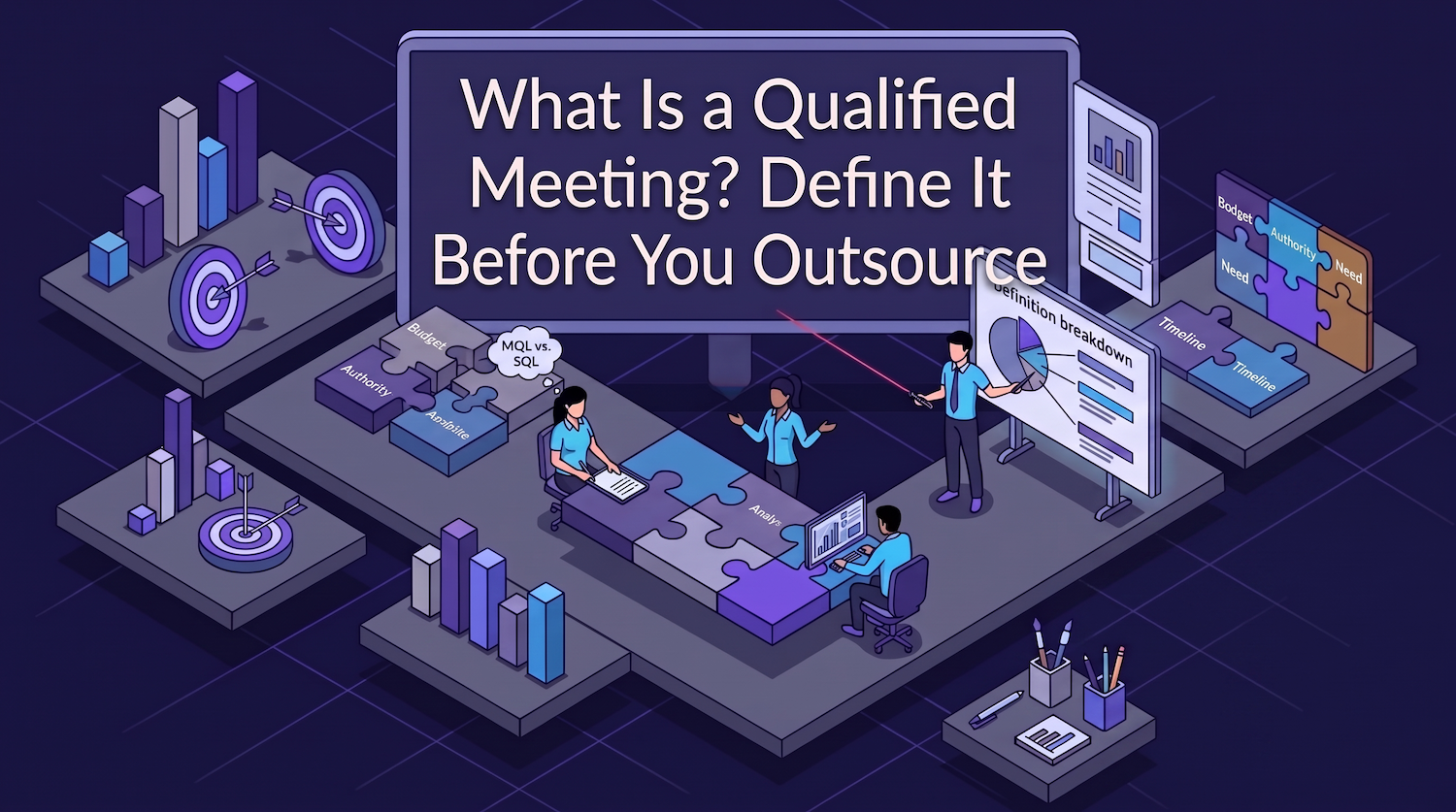
TL;DR — There is no industry-standard definition of a qualified meeting, and there shouldn't be. What counts as qualified for a £4,000 product is not what counts for a £400,000 one. Agree it in writing before outreach starts, specific enough that either side can look at a meeting and say plainly whether it counts. An argument about meeting quality is what it looks like when quality was never defined.
To optimise your sales pipeline to its fullest potential, it is crucial to regularly ask the right questions to find any hidden prospects, areas that need to be fixed, and what strategies can be adjusted.

Customer-Centric Approach
Both sales and marketing are ultimately concerned with engaging and converting customers. Sales teams play a crucial role in understanding customers’ challenges and needs as well as addressing their doubts; While content marketing utilises this information to develop tailored content that resonates with the audience better and drives home the brand message more convincingly. By coordinating their strategies, sales and marketing can better target and guide prospects through a tailored experience, from initial interaction to purchase decision.
Shortened Sales Cycles: Sales teams frequently encounter long sales cycles because potential customers typically require different touchpoints before reaching a decision. By creating customised content that caters to every phase of the buyer’s journey marketers can play a role, in educating and guiding prospects ultimately preparing them for making a purchase. This approach speeds up the sales process and leads to quicker closures.
Improved Lead Quality: Content marketing naturally draws in customers through blog posts materials such as guides, webinars and engagement via social media platforms. By involving sales teams this content can be enhanced to attract quality leads. Sales teams have the ability to offer insights into the kinds of customers that are more likely to convert successfully. This input enables the content team to tune their strategies to focus effectively towards reaching these ideal customers.

Consistent Messaging: Inconsistent messaging between sales and marketing can confuse prospects and undermine trust. By collaborating, both teams can ensure consistent tone, language, and value propositions, ensuring prospects receive a unified message whether engaging with marketing content or directly with a salesperson.
Benefits of Integrating Sales and Content Marketing
Improved lead nurturing and conversion rates: Combining sales and content marketing enhances customer experience. Tailoring content for each customer journey phase helps nurture leads efficiently and boosts conversion rates. Regularly providing prospects with content ensures they are better informed and ready for engagement, with the sales team.
Increased efficiency and productivity: Collaboration between sales and marketing teams streamlines tasks. This boosts efficiency by eliminating work and enabling more targeted content creation that meets sales requirements practically and effectively.
Better ROI on marketing efforts: Integrated sales and marketing teams can prevent the misallocation of resources towards campaigns by ensuring that content is tailored to meet sales goals and resonate with the intended audience effectively resulting in targeted campaigns yielding better leads and increased ROI.
How to Effectively Integrate Sales and Content Marketing
Collaborate on Content Creation
Sales teams can leverage insights on clients such as industry background, job responsibilities and pain points. Marketing can then use this information to craft tailored content that connects with audience segments to boost engagement and relevance.
Use Content As A Sales Tool
Content should not just attract customers, but also serve as a helpful resource, in the sales journey itself. Salespeople can provide articles, videos and other materials to enlighten prospects, about their problems and possible ways to solve them. This strategy establishes the company as a source of information. This will in turn enhance the probability of finalising a deal.
Collaboratively Measure Success
To achieve integration between sales and content marketing teams, departments should actively exchange metrics and insights. The marketing team can monitor the performance of content that resonates with the audience while the sales team can evaluate how these engagements impact conversion rates. Creating a dashboard or organising frequent review sessions will help maintain consistency in assessing the outcomes of the strategies being put into action.
Strengthened Brand Positioning
A unified sales and content marketing strategy strengthens brand authority in the marketplace. When these teams collaborate effectively they can offer prospects a personalised experience that boosts sales, shortens the time taken to make a purchase and enhances the effectiveness of campaigns. This leads to a unified business set up for long-term growth and prosperity.
In the era of technology and online presence, companies are becoming more and more dependent on aligning their sales tactics with their content marketing efforts. Historically these two divisions have worked independently; sales concentrated on finalising transactions while marketing developed messages to entice customers. Nonetheless combining sales and content marketing generates a collaboration that enriches the customer journey and boosts company success. So why should sales and content marketing work together?

Information Technology & Services
There is a lot of competition as new solutions keep popping up. People who are looking for these services are usually knowledgeable about technology and have thoroughly done their research. Companies need more than just a great product, they need a strong outreach strategy to cut through the noise. Because of the sales processes and intricate offerings involved in this field companies should rely on sales development teams to inform customers, establish trust with them and help them understand the technical aspects of their products more clearly. Sales development focus areas
- Lead qualification through technical demos.
- Multi-touch outreach strategies.
- Nurturing leads during long sales cycles.
- Establish rapport for projects and customer relationships.
Healthcare & Medical Devices
The healthcare sector deals with a purchasing process that requires input, from parties such as doctors, administrators and procurement departments. These processes are further complicated by regulations and compliance issues that influence the sales cycle significantly. Sales development groups are instrumental, in informing clients about product advantages and addressing concerns while ensuring consensus among all stakeholders involved. Sales development focus areas
- Building relationships with decision-makers.
- Navigating regulatory requirements.
- Tailoring messaging to meet compliance and safety standards.
Financial Services
This industry relies heavily on trustworthiness and customer loyalty to thrive. Whether dealing with investors or corporate customers establishing trust from the outset is crucial, for financial institutions sales development plays a role, in identifying potential clients building credibility and fostering long-term connections. Sales development focus areas
- Handling sensitive financial information securely.
- Personalising outreach based on client needs.
- Establishing authority and trust early in the sales funnel.
Manufacturing & Industrial
Frequently confronted with sales periods and hefty contracts, for products that demand substantial investments to thrive in the market space; numerous enterprises within these realms grapple with insufficient in-house capabilities to consistently secure new business opportunities and oversee the progression of sales activities. Sales development focus areas
- Lead qualification for capital-intensive projects.
- Emphasising the benefits of a product.
- Managing multi-stakeholder decision-making processes.
Professional Services
Professional service firms such, as consulting agencies and legal services providers heavily depend on their reputation and client recommendations to attract business; in the face of increasing competition, they must adopt an assertive strategy for generating leads to stay ahead in the game. An effective way for them to reach out to clients is by leveraging sales development services that enable them to connect with decision-makers and industry leaders needing specialised skills and knowledge. Sales development focus areas
- Targeted outreach to C-level executives.
- Positioning the firm as a thought leader.
- Managing longer lead nurturing campaigns.
E-commerce & Retail
With the rapid shift toward online shopping, e-commerce companies must be proactive to attract new customers effectively to stay competitive. With a strong emphasis, on digital marketing strategies, many e-commerce brands find value by also investing time and resources into developing sales strategies that aid them form lasting relationships with key B2B partners, like distributors and retailers. Sales development focus areas
- Identifying high-value partnerships.
- Navigating B2B deals for distribution.
- Personalising outreach to key business accounts.

Real Estate & Property Technology
In the real estate sector, especially in property technology, businesses face long sales cycles, with significant transaction amounts and involvement, from various decision-makers. Sales teams dedicated to development play a role in establishing connections with buyers and investors or collaborating with business partners seeking comprehensive details, about the available solutions. Sales development focus areas
- Managing high-value client relationships.
- Educating clients about technological advancements.
- Driving interest in long-term investment opportunities.
Logistics & Supply Chain
Logistics and supply chain companies often operate on tight margins and need to maximise efficiency in lead generation and sales processes. These industries rely on a sales strategy that swiftly reaches stakeholders and sets their offerings apart.Sales development focus areas
- Quick qualification of time-sensitive leads.
- Personalising outreach for supply chain managers.
- Navigating complex service agreements.
- Outline service-level agreements.
Why Sales Development Services Are Crucial Across These Industries
Although these sectors differ greatly in the goods and services they provide they face similar obstacles that sales development services can tackle:
- Long sales cycle
- Complex products or services
- High competition
- Compliance and regulatory hurdles
Sales development services enable companies to create a focused sales pipeline that enhances generation efficiency and accelerates sales processes, for sustained business growth.
Sales development is crucial for businesses across various sectors, but some industries stand out due to their high competition, complex buyer journeys, and evolving customer expectations. For companies operating in these industries, having a dedicated sales development strategy can significantly impact lead generation, revenue growth, and market penetration.Our team has jotted down some industries that can benefit from specialised sales development services and the areas the different industries need to focus on.

This is where the art of human-led copywriting takes the stage. These 5 copywriting tips leverage principles from behavioural insights to create messages that connect by grasping people’s motivations and decision-making processes while evoking their emotions effectively. When used in emailing or direct messaging, these strategies can help elevate a message into an engaging icebreaker.1. The power of personalisationGoing the extra mile involves more than inserting the recipient’s name in the subject line of your email; it entails showcasing that you've thoroughly grasped their obstacles and aspirations. Alluding to a success or a trending topic within their industry that they're probably interested in following in your message shows that your email is not merely a generic template but a customised answer to their needs. Personalisation is a concept that plays into the human desire, for acknowledgement and significance; people tend to respond more favourably when they feel acknowledged and empathised with.2. Leveraging social proofWhen sending an email it can be beneficial to boost your credibility and persuasiveness by incorporating testimonials, customer stories and references, to shared connections. Understanding the principle of validation can help alleviate uncertainty and offer reassurance to individuals considering your proposal by showing them they are not alone, in their decision-making process.3. Creating a sense of urgencyA well-placed sense of urgency can be the nudge needed to prompt a decision. It involves emphasising the potential benefits that might be missed if the person doesn't take action, whether it’s securing a meeting slot or seizing an exclusive offer that won't last long. Creating a sense of urgency taps into the fear of missing out which can be a driving force that can prompt action when presented genuinely.4. Using the curiosity gapWhen you introduce a sense of intrigue without revealing all the specifics it motivates readers to delve to satisfy their curiosity themselves. For instance, a headline such, as "The method that skyrocketed our client's generation by 300%" provides just enough hint to make clicking on an email too tempting to resist.5. Applying the reciprocity principlePeople usually reciprocate favours given to them by others in return, for something they receive initially without any expectations in mind such as a resource or useful advice that triggers their sense of reciprocity naturally upon receiving a cold email that offers genuine value rather than just seeking a response, from the recipient.
Harnessing Human Connections
The primary objective of using these copywriting tips in emails and direct messaging goes beyond increasing open rates or arranging meetings; they aim to establish relationships and cultivate trust in a saturated online environment. By incorporating these insights into your cold email approach you shift from interrupting someone's day to initiating a dialogue they find valuable. It's not always about making a sale, it's about building business relationships.
With decreasing attention spans and constant connectivity everywhere you look, sending cold emails has transformed from a mere numbers game to a thoughtful strategy that requires finesse and skill. Simply blasting out messages and crossing your fingers for a response is no longer sufficient, in making connections, with potential clients; we must delve deeper into understanding human behaviour at its core.

1. Culture
The environment in which your sales team operates is crucial in determining the quality of results. At Pipeline our company culture is one which unashamedly values high performance. Everybody in your sales team should be striving, at all times, to be delivering results, while continuously learning and improving. Try to create a culture that lauds success; teammates should be cheering one another on, while simultaneously endeavouring to do something special themselves. Praise is also an important aspect of this; as a leader, you have a responsibility to recognise great work and make sure that the producer of that work is given praise for a job well done.Sales is all about numbers, and as such if you can centre your sales team’s culture around metrics, so everyone knows how they are doing against predefined objectives, this will ensure the team is working hard to deliver. Clear, up-to-date metrics will fuel your team’s desire and ensure that everyone is relentless in achieving the goal.Accountability is a word which gets thrown around a lot in the business world, but which rarely is properly applied. Everyone in sales should be accountable, from leadership all the way to the junior recruits. For accountability to become entrenched in company culture, those in leadership must be accountable for their work and actions. Junior team members are not going to adopt this ethos if they don’t see it from senior colleagues.At Pipeline, while we obsess about winning, we also make space for team members to be vulnerable. Vulnerability is the single biggest source of real bonding between team members. If someone feels safe enough to say “I’m really struggling with x or y, does anyone have any ideas?” then you have a great culture and therefore, a strong platform for success.It’s also important to cultivate an environment in which people can have fun. Sales is a tough job with significant pressure, and if people are not able to enjoy themselves, have a bit of a laugh and unplug from the grind, results will eventually suffer.
2. Standards
At Pipeline, we live and die by high standards. Every person we meet, every phone call we make, every email we send and every proposal we write to adhere to the highest possible standards in terms of professionalism, design and grammar/punctuation.Pride in your work is critical to succeeding in sales. If a prospect receives any form of engagement that is not up to scratch, your chances of a closed deal diminish extremely quickly.High standards also apply to efficiency. Team members need to be constantly looking for ways to do things better and quicker, maximising the time available to boost results. Make sure you apply rigorous standards to how efficiently people are working; there is no place for wasted time when looking to boost productivity.When looking to improve your sales outcomes, set very standards, reiterate them and ensure that any work which is below par is identified and improved immediately.
3. Resilience
Everybody who works in the sales profession will tell you that it's an unforgiving job; sales is not for the faint of heart. Therefore, you have to have a resilient team if you want to get the best results.Whether you’re in a feast or famine state, you have to make sure your sales execs are mentally tough and can crack on through whatever is thrown at them. Some people are naturally tougher than others and in your recruitment process, a key character trait you should be looking to identify is stoicism.Furthermore, you can build your team’s resilience through correct training exercises. For all recruits, but especially juniors, from the word go you need to be putting them through their paces, taking them outside of their comfort zones and deep into their growth zones. Only by enduring tougher situations can an individual and a team learn what they are capable of, and how much they can withstand.While management and the wider team should always be sympathetic and supportive, a base level of resilience must permeate the entire sales team to ensure that output is maximised, no matter the market conditions.
4. Work Ethic
Work ethic seems like an obvious area to touch upon, but nonetheless, it is something that we find is a major differentiator for us at Pipeline. We thrive on hard graft. We are not bothered by long hours or demanding projects, indeed we relish a good battle.If you are looking for consistent sales success, then you need team members who like to put in a shift. People who spend the final 30 minutes of the day shuffling papers and waiting to dash out of the door at the stroke of 5, or who look for any excuse to down tools, won’t realistically be an asset in a high-performance sales team.Work ethic is tied to culture and as a leader, you need to be vigorously emphasising the benefits of diligence and commitment. It is also important to help your sales team to think long term: yes the next month might be a slog, but think about how good it will feel at the end of it when the job is done.
5. Training & Development
As with work ethic, the importance of training and development seems fairly obvious, but we are shocked by how often this vital aspect is overlooked or sidelined by our clients.Assuming you don’t have the Sales Messiah working in your team, everybody can learn something no matter how senior. Investing heavily in the development and training of your team will deliver exponential returns by lifting results, boosting staff retention and acting as a strong talent attraction tool.At Pipeline we focus relentlessly on talent development, everybody in the company is on a demanding career development plan, we have a carefully crafted training programme and we encourage all of our existing team to assist in training new team members.The results are staggering in terms of team ethos, an ever-expanding skills portfolio within the team and most importantly, the quality of the sales results that we generate. You need to think long and hard about how you are coaching your sales team if you want them to perform at the highest level. It doesn’t need to cost the earth and you’d be amazed at the amount of resources you already have in-house once you start strategising.
6. Incentives
The very best salespeople will tell you it’s not about the money, it’s all about winning and money is just a means for keeping score, but despite this, sales professionals are undeniably money motivated. It is, therefore, very important to have a great incentive scheme in place. Your scheme should push your sales team to perform and offer substantial benefits for smashing targets. It should also be simple; having to complete the equivalent of a Sudoku to figure out how much commission is due, is not going to motivate a sales team.We have seen countless examples of sales teams with incentive schemes which are either not remotely motivating, don’t offer much earning potential or are so complicated that the sales execs just switch off.Get your scheme right and watch your sales team go bananas to get paid the big bucks.
7. Communication
The final pillar that we want to talk about is communication. It is hard to emphasise the importance of clear, consistent communication if you want to maximise results. Leaders can’t share every tiny detail with their sales teams, but team members do not like to be left in the dark or to feel like they are paddling around without any clue as to why.Make sure that objectives, expectations and anything else important are defined and communicated with the sales team. If a target has to be larger than expected, explain why. If an item is of high strategic importance, let the team know about this and give them the context. Involve your team in what is going on, so they can help drive the business in the right direction. You owe it to your team to be as transparent as you can be; your team will respect you more and you’ll be amazed how far people will go to get the job done if they are brought into the loop.
Consistently Delivering Sales Excellence
Delivering sales excellence requires a lot of the right ingredients and is something that the whole team has to continuously work on. From our experience, however, we would argue that the amount of effort is totally worth it. Not only will you improve your sales output, but you will create a fun and engaging environment, in which people form real bonds and great achievements are realised.By focusing on these 7 core pillars, you can unlock results that previously seemed impossible. While some quick wins will deliver swift benefits, you should be aware that everything we recommend in this article takes time to implement successfully and requires commitment to get right. By being intentional and purposeful in your pursuit of sales excellence, you will improve your chances of success.As with everything, some trial and error will be needed; every business is different and there is no one-size-fits-all solution, but think about the seven areas we have discussed and how you can design each one to work for your company, and you’ll be well on your way to consistent sales excellence.
Sales is as much an art form as it is a science, and it is a discipline which we find is heavily influenced by the cultural setting in which it is practised.At Pipeline, we are a collective of sales professionals who offer outsourced sales personnel solutions to our clients. All of us actively engage in selling all day, every day, working with a wide range of clients, from various sectors. As such, we take great pride in the levels of sales performance that we deliver and our range of experience.There’s a lot of information flying around about how to achieve sales success, and of course plenty of companies offering incredible sales results through the magic of AI. To cut through all of the noise, we wanted to provide our community with a comprehensive guide to consistently delivering sales excellence.There are seven fundamental pillars that you need to have in place:

1. Cost
As touched on above, hiring is an expensive business activity. When looking at hiring sales professionals an employer has to factor in recruitment fees, salaries, commission, Employers’ National Insurance, capital costs associated with equipment, sick pay, holiday pay, parental leave and the potential costs associated with lost revenue should the individual’s performance not be as hoped.With so many layers to the cost base for each hire, many of which are variable, cost is a major reason for considering an outsourced sales personnel solution. With a set monthly cost, agreed upon for a certain period, companies can budget with precision and confidence. Knowing exactly what your sales team will cost over a defined period is a huge benefit of outsourcing.Reducing costs without affecting output is what all business leaders are aiming to do, and outsourcing your sales function is an excellent way to achieve this.
2. Time
Next up is time. Our clients tell us that saving time by working with an outsourced sales team versus in-house hiring, is a major benefit. When looking for full-time sales staff, an employer has to consider the time needed for sifting through CVs, the time required for running first, second and maybe even third round interviews, the time needed for onboarding and training, the time required for ongoing management and lastly, the necessary time and energy should an HR-related issue were to arise.When broken down this way, one can see that the time investment is massive for each in-house hire. An outsourcing option removes the majority of these time requirements; a company such as Pipeline has already hired and trained full-time staff, manages them on an ongoing basis, deals with any HR issues, pays their salary and applicable taxes, manages their leave and so on. As an employer, your only time commitment will be a brief onboarding session with your exec or any required weekly meetings.Outsourcing is great in this sense, as it provides all of the output of great salespeople, with very little time needing to be input from you.
3. Risk
Our clients tell us that another major upside to outsourcing is risk reduction. Since the fees associated with taking an employer to tribunal were removed, there has been a vast increase in the number of employers being taken to tribunal. If it is not working out with an employee, for whatever reason, you need to let that person go. You run the risk of a costly and time-consuming ordeal at a tribunal, usually with a no-win-no-fee lawyer on the other side of the fence.Outsourcing removes this risk altogether; if you need to stop working with your outsourced sales company, you can do so without any HR recoil. The contract expires, a handover is conducted and both parties move on without repercussions. This is a significant point of value provided by outsourced sales companies.Another ongoing risk is that of resignation; you have spent a lot of money and time bringing someone into your team and then they get a better offer (which is likely in this fiercely competitive market) and off they go. With an outsourced option, this will never happen. Even if the sales rep working on your account were to become unavailable if you were working with Pipeline Professional Services, we will place a new rep on the project that same day, so you don’t lose any momentum. The same is true if your rep is unwell, we fill in the gap with another member of our team, to ensure zero downtime.
4. Flexibility
The final primary reason for considering an outsourced sales option is the matter of flexibility. With in-house staff, an employer has pretty much no flexibility. Whether you are launching a new product, the nature of your business is cyclical, or if there is a downturn, the inflexibility of permanent staff can be a substantial challenge for employers. Outsourcing offers a solution to this problem, allowing businesses to scale or reduce their sales workforce in line with the ebb and flow of their business operations.Having the space to plan precisely headcount and associated costs or move things around as the market evolves is a considerable benefit, especially when you consider the erratic nature of the global economy. Outsourcing your sales team provides valuable flexibility when navigating the choppy business environment.
Why Outsourcing Is The Way To Go
As with all business decisions, there are pros and cons when considering outsourcing some or all of your sales operations, but the general feedback we get from clients is that the benefits of outsourcing do outweigh the negatives, and as such, it is a solid investment.There is no such thing as a perfect solution and outsourcing does have some drawbacks, but if you can find an excellent outsourcing business, it is likely that you will enjoy highly positive outcomes.At Pipeline, we specialise in developing high-performance sales professionals that clients can access on-demand. This means all of the output with very little input. For companies struggling to find the right talent, or looking for a low-risk option with manageable and predictable costs, outsourcing their sales operations to Pipeline is an excellent option.
Talk to any business or sales leader and ask them what their top 4 challenges are; without exception, sales talent will be there somewhere. It is something that we hear from our clients on a daily basis. As the economy stabilises and companies want to drive growth, we hear time and time again that finding the right commercial talent is a nightmare.Even when companies are fortunate enough to make a hire, this typically comes with hefty recruitment fees, time spent training and onboarding, HR risk, capital costs and the ever-present risk of resignation. Furthermore, with salary inflation remaining one of the few areas where inflation is not subsiding, the cost of growing a team can be prohibitive.With all of this in mind, companies are looking for solutions, and one option that comes up is sales outsourcing. It can be hard to weigh up the pros and cons of an outsourced option, so in this article, we dive into the top reasons to consider working with a company such as Pipeline Professional Services, according to our clients.

Remember that post-COVID boom we were all promised? The line went something like this “Once the virus has been defeated, the economy will reopen and businesses will come out blinking into the sunlight, to be met by a roaring hurricane of demand.”That may have been true for bars and restaurants, and there’s no doubt that the travel industry has recovered a decent chunk of its losses, but for the wider economy, since the beginning of 2022 we have been dealing with severe political turmoil, rampant inflation, spiralling interest rates, conflict in Ukraine and now the Middle East, energy prices surging, massive layoffs (especially in the tech sector), record company insolvencies, healthcare backlogs, an economy teetering on the edge of recession and unabating difficulties in filling job vacancies.The nirvana hasn’t quite materialised, but as we enter 2024 there does seem to be some economic hope with inflation finally calming and the Services sector in particular showing strength. As the economy looks to move onto a more positive footing, business leaders are thinking about growth and how to generate revenue in this unforgiving market.But there is yet another obstacle: for most businesses, generating revenue means having a great sales team, and hidden amongst the aforementioned difficulties in filling roles, is a pernicious Sales Talent Crisis.It has never been harder to attract, develop and retain great salespeople. A recent study found that 46-50% of new hires into the sales division fail within 18 months, and we have heard plenty of anecdotal evidence suggesting that for many new sales recruits, 18 months would be considered somewhat of a win. Sales leaders and HR teams are spending far too much time trawling CVs and sourcing candidates, going through what is often a painful interview process and then ending up hiring people who are not ideal for a career in sales, which in turn leads to HR issues and Sales managers spending too much of their time dealing with ineffective reports.As a result, companies are consistently missing targets which is suboptimal, especially in the current climate. Business leaders, looking to justify underperformance are quick to blame the economic landscape, which undoubtedly is playing a part in all this. However, in reality, our research suggests that the wider economic environment is only partly to blame and a major factor contributing to commercial underperformance is a lack of sufficient sales talent.So what’s going on? Our work suggests that there are two primary drivers behind the sales talent crisis. The first is a general lethargy across the workforce following the pandemic and the second is a rapidly shifting approach to work from the younger generations, two issues which we will assess in turn.
The massive increase in working from home, either partially or completely, while popular with workers looking to avoid the commute, is undoubtedly having a negative impact on productivity. This is especially true in a sales environment, which ought to be a high-energy, fast-paced environment in which sales reps are working as hard as possible to find opportunity and convert it into business. We see no way in which an energetic sales floor can be matched by isolated reps working from their dining room tables. Furthermore, there is no means for leaders to properly motivate and energise their teams over Slack. A further challenge with remote work is training and development; for the most part sales coaching is most effective in-person, one-to-one sit downs with managers are most effective in-person and team meetings in which individuals can support one another and feel a sense of unity, is most effective in-person. It’s a catch-22 for employers because 45% of employees say they would stick with a company if they offered training and development, yet it’s a complicated task to deliver decent training remotely.
The effects of the issues listed above are compounded by the fact that a severe talent shortage means companies will perhaps take a more lenient approach to missed targets, which facilitates a lax mentality among sales teams who know that they are essentially unsackable and that leadership will just blame the economic landscape if commercial results are below expectations.Many sales professionals we speak to take umbrage with our assertions around remote work, claiming that they are just as, if not more productive working from home than in an office environment. No doubt some hyper-focused individuals can deliver the goods regardless of their daily location, but for the most part, if we are all truly honest, we know working from home is not delivering optimal results, even if it does mean we can fit in a gym session when we would have once been at our desks.The second primary driver in the Sales Talent Crisis is the shift in mindset towards work, from the younger generations entering the workforce. This cohort of youngsters is much maligned as a pack of lazy and entitled snowflakes. While there may be aspects of that, we believe that really this is a group that is misunderstood and who has been dealt a pretty awful hand. To put things into context, on average sales execs aged 20-34 stay with an employer for 2.8 years, while those aged 50-65 average 10.1 years with an employer.There are many reasons for this, but a desire for flexibility seems to be a major factor for younger people. This is a group with far more awareness around mental health and a larger focus on work-life balance than may have existed in the past. All of us who work in sales know that you have to be extremely resilient to make it and that at times, work-life balance has to take a backseat; these facts seem to create a clash for younger workers between their personal priorities and the demands of a career in professional sales, which is contributing to lower applications upfront and higher churn once people are in a sales role.At the end of 2024, we spoke to a recent grad, who was leaving her job in sales after just six months to take up a role in HR. In her words, the reason was, “I don’t think I can handle the emotional roller-coaster of sales.” This sums up the situation for many new recruits, and we feel the challenges of working in sales are not being properly addressed by hands-on management, again because of remote or hybrid working patterns.The clash between what younger people want personally and what a sales job requires is a clear contributory factor to the junior end of the Sales Talent Crisis. We have explored some of the key personality traits for a successful sales career, and unfortunately again and again, we find the required elements, are not compatible with the type of day-to-day existence desired by many young people:
- Resilience
- Discipline
- Grit
- A willingness to work, long and often irregular hours
- Resourcefulness
To do well in sales, there is a degree of sacrifice required; you have to compromise on certain other aspects of your life and this is why the earning potential is so fantastic. Unfortunately, the always-on, instant gratification culture that is fuelled by an entire generation’s addiction to social media is struggling to find a home in sales.Furthermore, there are other factors to consider such as the cost of living and particularly the extremely high costs of home ownership. For previous generations, it was easy for individuals to see that if they stuck it out with a job, they would do well and soon be able to get on the property ladder. These days, home ownership is nothing more than a distant dream for most young people, and therefore why would they work themselves to death in pursuit of it? Much better to earn enough money to go to Croatia to load up on selfies.This is why we see social media phenomenons such as Quiet Quitting and #LazyGirl - which essentially advocate doing the bare minimum to earn a salary which gives you a rough equivalent of a satisfactory lifestyle, and that’s that. With many young people subscribing to ideas like this, you can see why the last thing they would want to do is get into sales.While, of course, many of these assertions are general and do not apply to everyone in the groups they address, they characterise a climate in which sales teams are not delivering anything close to maximum output. The outcomes for businesses are missed revenue, HR risk and increased costs, coupled with wasted time. It is a problem, which unless fixed, will result in lower revenues at the company, sector and economy level. With less revenue being generated, there is less to be spent, making sales an increasingly harder endeavour. Which, in turn, contributes to the Talent Crisis and ultimately we end up in a downward spiral.So, what can companies do to solve the Sales Talent Crisis and negate the negative impacts that a lack of talent is having on their businesses? One solution is to work with companies such as Pipeline Professional Services, which offer remote sales teams. Our staff are all based in Cape Town and as such are hungry, hard-working professionals who have gone through extensive training. Our team works for us full-time and lives and breathes sales. Your sales exec would plug seamlessly into your systems and wider team as if they were a full-time employee for the duration of the engagement. However, as they work for us, you do not have any of the headaches that come with an in-house employee:
- No recruitment fees (which are charged even if the individual doesn’t work out)
- No Employer’s National Insurance
- No HR or Legal risk
- No IR35 risk
- No sick pay
- No holiday pay
- No parental leave
- No interview process
- No training
- No risk of resignation
- No equipment requirement
- No desk space requirement
In unison with these benefits, businesses can enjoy the output provided by diligent salespeople.We have created this solution to help with the challenges we experienced as Sales Leaders. It’s impossible for leadership to do a sufficient job without the right personnel. Finding the right personnel is complex, so we created Pipeline to make it easy.
emember that post-COVID boom we were all promised? The line went something like this “Once the virus has been defeated, the economy will reopen and businesses will come out blinking into the sunlight, to be met by a roaring hurricane of demand.”

