

Pipeline Blog
Actionable sales, outbound, and GTM insights from the team building pipeline every day.

Run a nine-question post-mortem
The first five questions identify what you experienced:
- Did the agency over-promise and under-deliver?
- Were expectations misaligned?
- Was there a lack of transparency?
- Were plenty of meetings booked, but very few converted?
- Were too few meetings booked?
The next four help explain why:
- Where did the data come from, and was it fresh and validated?
- What changed between the first and third month?
- What did the technology actually do?
- What access did you have to the person making the calls?
These are different failures and require different remedies.
1. Over-promising and under-delivery
Over-promising begins in the agency’s sales process. If the forecast used to win the contract was unrealistic, the engagement was measured against the wrong expectation from the start.
Changing supplier may solve this, but only if the next provider sets expectations using evidence rather than another generic meetings promise.
2. Misaligned expectations
Misalignment is usually a specification failure.
Before work begins, both sides should agree what a qualified meeting means, who can decide that a meeting does not count and how long the ramp period is expected to take.
Without that agreement, the client and agency may be working towards different definitions of success.
3. Weak transparency
Weak transparency is a reporting failure.
Before signing, establish what reporting you will receive, how often and in how much detail.
Headline activity figures are not enough if they do not explain what is working and what is changing.
4. Plenty of meetings, but few conversions
This is an outcome rather than a diagnosis.
The meetings may have been poorly qualified or aimed at the wrong buyers. But also examine the internal sales process: qualified meetings are difficult to close when follow-up, skills or capacity are weak.
Were the meetings fundamentally wrong, or were suitable opportunities not converted after handover?
5. Too few meetings
Low meeting volume can be caused by an unclear ideal customer profile, weak messaging, poor data, ineffective execution or a lack of optimisation.
Increasing activity does not fix those problems. It normally exposes more of the same audience to the same ineffective approach.
Examine how the campaign was operated
6. Was the data fresh and validated?
People change jobs, companies are acquired and domains change.
An SDR working from stale data wastes time on dead addresses and wrong-fit companies. Activity cannot compensate for that.
Ask where the data came from and how it was cleaned, enriched and validated.
7. What changed over time?
Segmentation and messaging are hypotheses, not permanent settings.
If nothing changed between month one and month three, the campaign was executed rather than optimised. It should generate evidence about which companies, buyers and messages produce engagement, and that evidence should shape what happens next.
8. What was the technology actually for?
“Technology-enabled outbound” can mean two different things.
Personalisation at scale multiplies output, but the edge comes from utilizing tools and AI for tasks such as account scoring, context gathering, drafting and SDR feedback and training. The difference shows up in meeting quality more than count.
The strongest use of technology supports human judgement rather than replacing it.
9. Did you have access to the SDR?
Hearing your product pitched cold by the person representing you shows whether they understand your value proposition, buyers and likely objections—and whether they can hold a credible conversation.
Would the failure follow you?
Three things need to be in place for outsourced sales development to work:
- A clear understanding of who your customers are
- A value proposition that survives a cold conversation
- Someone internally with the capacity to close what gets booked
Change the supplier in your head while leaving everything else untouched. Would the outcome improve?
If not, another part of the system also needs attention. That does not excuse poor agency delivery; it reduces the risk of repeating the failure.
What to agree before signing again
Three agreements remove much of the ambiguity that damages outsourced outbound engagements.
Whose definition of a qualified meeting applies?
Our view is that the standard should be the client’s and agreed before work begins.
Qualification is part of the targeting specification. Whoever defines it influences who is contacted and which conversations reach sales.
What reporting will you receive?
Ask exactly what you will see and how frequently you will see it.
Useful reporting should show what is happening, what is being learned and what is changing as a result, not simply confirm that activity took place.
When will feedback happen?
Provide feedback after every meeting from the beginning. Explain what was relevant, what was not and whether the opportunity matched the agreed criteria.
Do not wait until 20 meetings have taken place before saying they are wrong. Until feedback is provided, the agency continues working from the original specification and any misunderstanding is repeated. We ask for feedback on every meeting to ensure we’re delivering as expected.
How we do it at Pipeline
After a failed engagement, the next provider should be able to show how its delivery model addresses the causes you have identified—not simply make a different promise.
A strong partner should demonstrate five connected capabilities:
- Qualification: Meetings are assessed against criteria agreed before outreach begins, so both sides share the same definition of suitability.
- Data and targeting: Target lists are built and refined using clean, enriched data rather than treated as a one-off input.
- Execution: Messaging is tailored to the market, buyer and problem, then adjusted as the campaign produces evidence.
- Optimisation: Activity, engagement and outcomes influence targeting and messaging while the campaign is running.
- Reporting and access: Clients can see what is happening, understand what is changing and communicate with the people managing and delivering the work.
Underneath all five sits the ICP and messaging work completed at the start of an engagement. Technology supports account scoring, context gathering, drafting, campaign analysis and SDR development. Its role is to make an expert SDR better at the job, not replace them.
Clients also meet the person working on their project and hear how they would pitch the product cold. This happens after they become a client, rather than during the sales process.
Frequently asked questions
How do I know whether the agency was the problem?
Look at where the failure occurred.
Unsupported forecasts, poor-quality data, weak execution, limited reporting and a lack of optimisation point towards the agency. However, unclear targeting, an unproven value proposition, slow follow-up or limited closing capacity may indicate that the problem was shared.
What needs to be in place before appointing another provider?
You need a clear understanding of your customers, a value proposition that works in a cold conversation and someone internally who can progress the meetings generated.
These foundations are required whether sales development is outsourced or built internally.
Before you sign anything
Answer the nine questions in writing before speaking to another provider.
The exercise will help you separate the failures that belonged to the previous agency from the issues that need to be corrected before the next campaign begins. That diagnosis should determine what you buy next.
If you want to work through the rebuild with Pipeline, we can begin with a one-month engagement to keep the initial risk low.
Sources
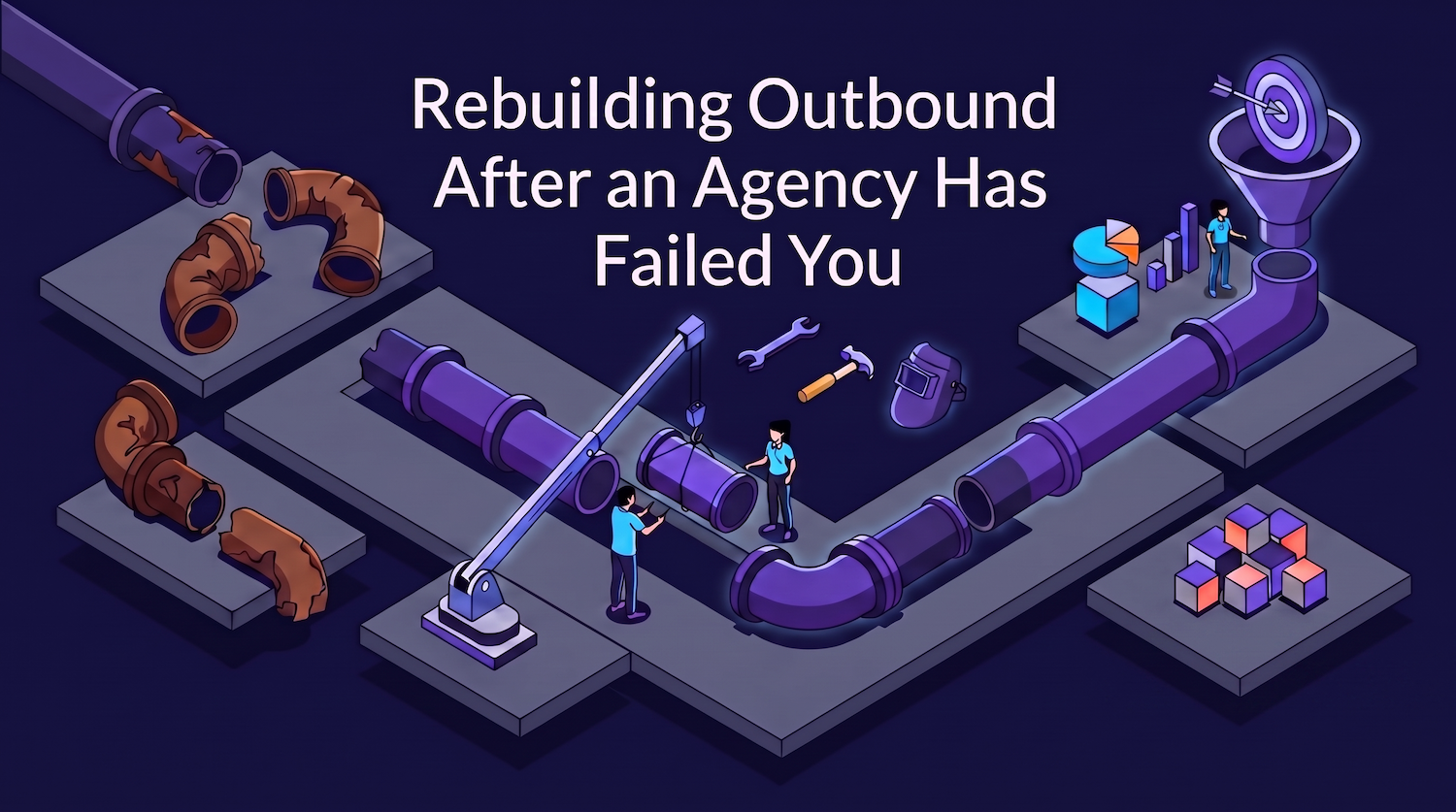
Before replacing an outbound sales agency, diagnose what actually failed.
A poor engagement may involve over-promising, weak transparency, poor meeting quality or too few meetings. The cause could be the data, a lack of optimisation, the technology or the person making the calls.
Changing supplier may solve some problems. Others may follow you.
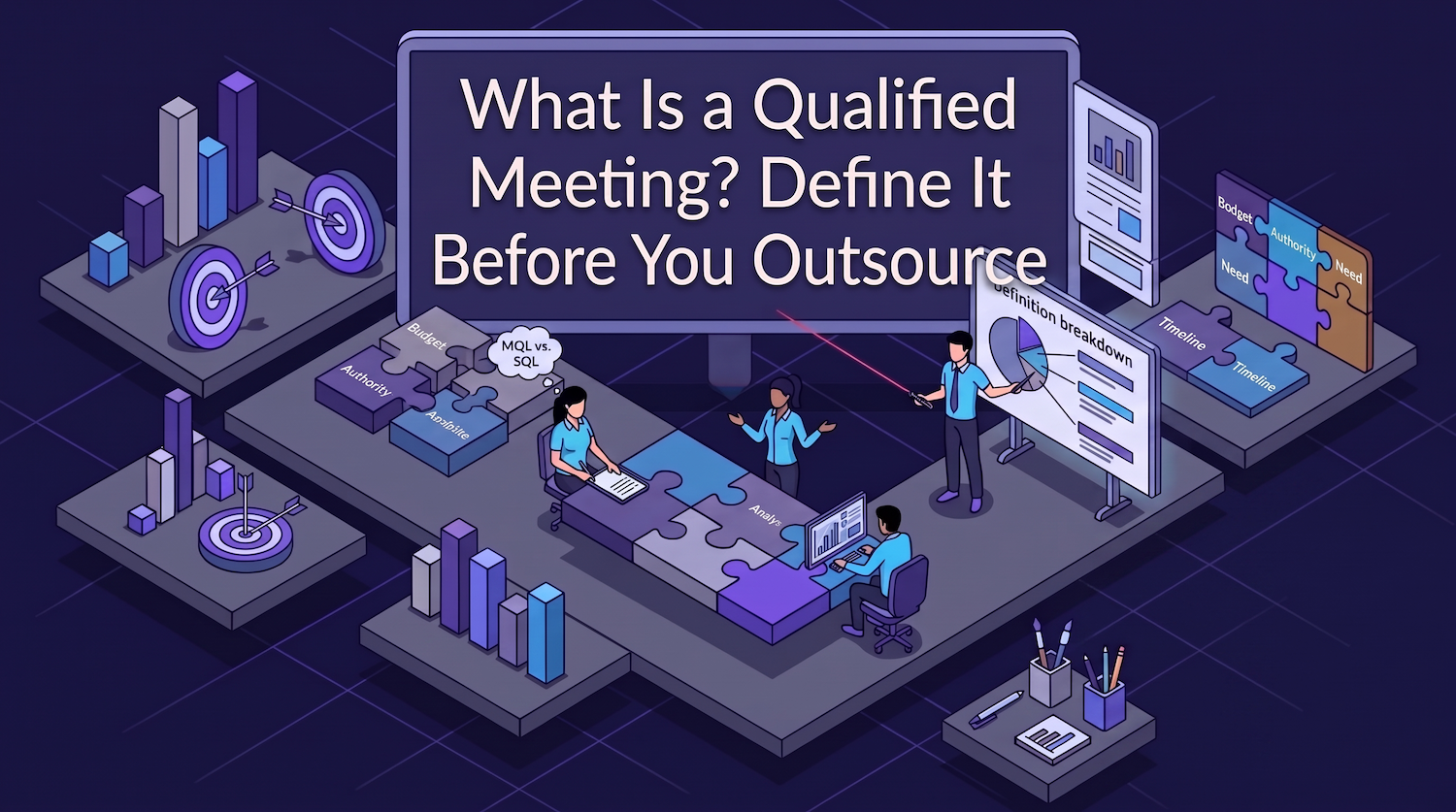
TL;DR — There is no industry-standard definition of a qualified meeting, and there shouldn't be. What counts as qualified for a £4,000 product is not what counts for a £400,000 one. Agree it in writing before outreach starts, specific enough that either side can look at a meeting and say plainly whether it counts. An argument about meeting quality is what it looks like when quality was never defined.
To optimise your sales pipeline to its fullest potential, it is crucial to regularly ask the right questions to find any hidden prospects, areas that need to be fixed, and what strategies can be adjusted.

Here’s how it works:
- You are a business leader and you need a salesforce which is reliable, consistent and effective.
- You are struggling to find great people to join your team and generate revenue in line with your objectives.
- You may have experienced a number of challenges when it comes to employing and managing full-time staff.
- We have interviewed, trained and hired a team of top class sales professionals in our office in Cape Town. Everyone who works at Pipeline Professional Services has been through our Sales Academy and shadowed an experienced team member for at least 3 months, to ensure a standardised high level of performance - this means that all of our team deliver excellent output.
- You can lease the services of one or more of our team members on a fixed term of project basis, for a set monthly fee. No interview process, no recruitment fees and no training required.
- You will benefit from trained hard-working staff, who seamlessly form part of your team for the duration of the project, without any of the risks and challenges associated with full-time hires; we simply plug into your systems and start selling.
- During the engagement, although we will be remote, we effectively form part of your full time team; we will join team/company meetings and report on progress.
- Your exec will report to you, however our management team will also be making sure that things are moving in the right direction in the backend.
- We guarantee 100% uptime during your engagement, so if the person working on your project gets sick, we will slot in another member of our team to cover until your usual exec recovers.
- At the end of the project, you can either choose to extend or expand the engagement or if your objectives have been hit, you can let the contract expire. When the project comes to an end we will do a thorough handover, log out of all systems etc, return any IP and disappear like ghosts.
Sales-as-a-Service is a unique offering which allows companies to access committed and skilful sales talent, without any of the pitfalls associated with the typical process of hiring individuals.
Our talent selection and training methods ensure that the base-level of performance for all of our staff is a high level. The benefit of this for clients is that they avoid the difficulty that some salespeople are less consistent than others. Many companies we work with have a few rockstars (20% of their headcount) who deliver around 80% of their revenue, with the remaining 20% of revenue coming from lower performance team members who are the majority of the team. When hiring for a sales role, it is very hard for employers to know if the individual is going to be a top performer or otherwise - we remove this risk because we only put team members who have completed our selective training process onto client engagements, thus guaranteeing quality.
Working with us allows companies to focus their commercial activities while managing their workforce. For example, if you have certain points in the year when you need to boost client acquisition, leveraging Sales-as-a-Service will mean you can get the business you need, without having to hire anyone or take a punt on freelancers.Equally, for businesses which work in clear cycles, such as event organisers, it is beneficial to bring in commercial firepower at certain points within the cycle. Sales-as-a-Service allows companies to do this, without the pressures and costs of full time hiring.You might be looking at an aggressive 6-month campaign focussed on new business and again, Sales-as-a-Service would be an excellent fit for this. We work with a range of scaling businesses, which need additional bandwidth in their sales department for a set period in order to expand, but they won’t necessarily need the headcount once a certain number of customers have been secured.Perhaps you need someone to fill in for a member of your commercial team who is on parental leave; Sales-as-a-Service would allow you to sustain your sales output without the risk of hiring someone for parental leave cover.As opposed to any specific needs as listed above, you may just be struggling to find any decent sales talent and this could be holding your business back. Once again, Sales-as-a-Service is the perfect solution, providing access to sales firepower, without any of the standard challenges, obstacles, costs and risks that come with hiring full time.
Pipeline Professional Services is a company which offers Sales-as-a-Service solutions to clients. What is Sales-as-a-Service and why should you care?To understand how Sales-as-a-Service is beneficial, it is useful to first understand what exactly it is: Sales-as-a-Service is a talent solution for companies, which takes all of the hassle out of hiring and employing in-house sales execs.

